
When we think about maintaining a commercial building, cleaning the HVAC system may not be the first thing that comes to mind. However, these systems continuously move conditioned air throughout schools, offices, municipal facilities, healthcare properties, and other commercial buildings. Over time, or following a fire, water loss, construction project, or other contamination event, dust, debris, soot, and other contaminants can accumulate within HVAC components and ductwork.
Before cleaning begins, there is an important question to answer: What type of ductwork system are we dealing with? Commercial buildings can contain several types of systems, and each material requires a different approach to cleaning. Understanding those differences is critical to cleaning the system without damaging it as air duct cleaning can involve much more than simply vacuuming the ductwork. Depending on the system and scope of work, HVAC cleaning may include the supply and return ductwork, registers, grilles, diffusers, air handling units, coils, drain pans, fans, motors, and other components.
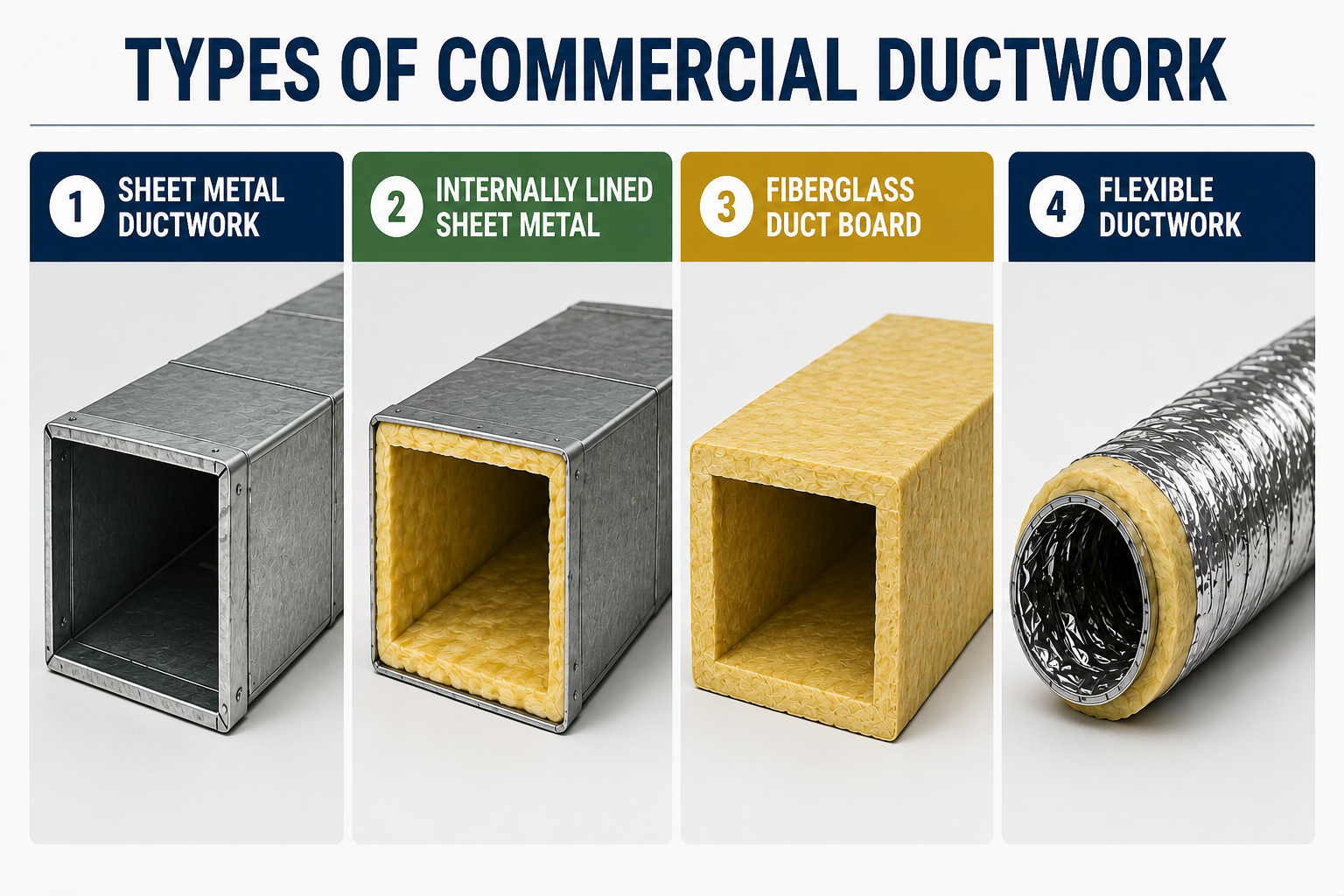
For commercial facilities, the National Air Duct Cleaners Association (NADCA) publishes standards and specifications for assessing, cleaning, and restoring HVAC systems. A professional cleaning begins with an evaluation of the system to determine its construction, condition, accessibility, and level of contamination. From there, the appropriate cleaning methods and equipment can be selected. Below are some of the different types of ductwork systems found in commercial buildings.
Sheet metal ductwork: Sheet metal is one of the most common type of ductwork found in commercial buildings. Its hard, nonporous surface can generally withstand more aggressive mechanical cleaning. Cleaning may involve placing the system under negative pressure while brushes, air whips, compressed-air tools, or other agitation equipment loosen debris. The material is then captured using specialized vacuum equipment.
Internally lined sheet metal ductwork: Some sheet metal ductwork contains fiberglass insulation on the interior for thermal and acoustical purposes. Because the lining is more delicate, cleaning methods must be carefully selected to avoid damaging or tearing the fiberglass. If fiberglass insulation has become significantly deteriorated, wet, or contaminated with mold, replacement may be necessary rather than cleaning.
Fiberglass duct board: Fiberglass duct board differs from lined sheet metal because the fiberglass material forms the duct itself. Its softer surface requires specialized cleaning methods that will not damage its structural integrity. The condition of the material is especially important. According to EPA guidance, wet or mold-contaminated fiberglass duct material should be replaced.
Flexible ductwork: Flexible duct, or “flex duct,” typically consists of a flexible inner liner supported by a wire coil and surrounded by insulation. Aggressive cleaning equipment can tear or damage the liner, so special care must be taken. Depending on the condition, accessibility, and extent of contamination, replacing sections of flexible duct may sometimes be more practical than cleaning them.
Air duct cleaning should be based on the condition of the HVAC system, not simply the age of the building. It is important to engage a NADCA certified firm to complete the assessment when there is substantial accumulation of debris, evidence of contamination, unexplained material being discharged from registers, or following an event that may have introduced contaminants into the system. Until next time my friends, be prepared and stay safe.
Reference: “Air Duct Cleaning Guidance” by EPA and Commercial HVAC Cleaning Standards & Resources” by NADCA